

Battery storage & inverters
Fox ESS
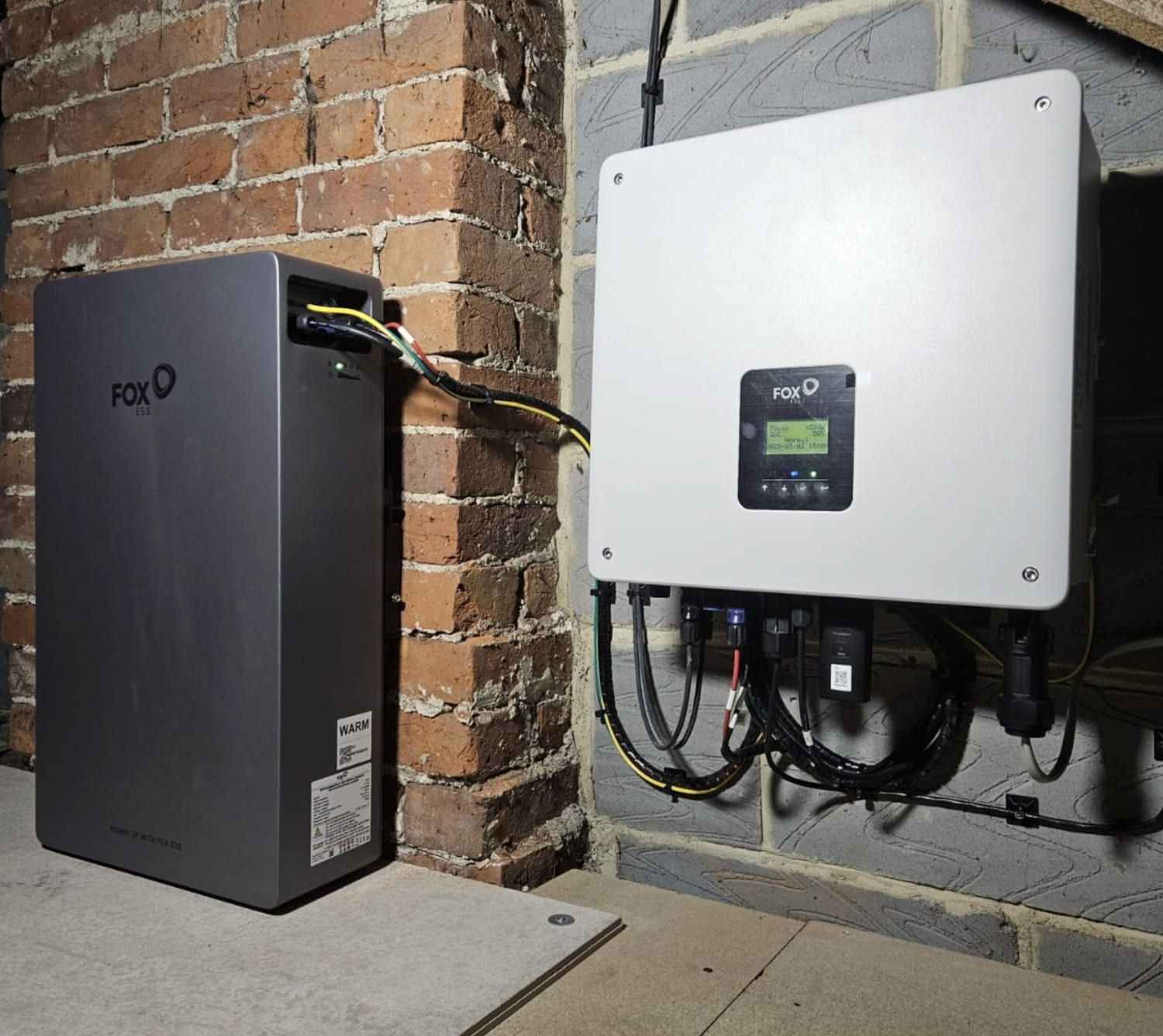
Fox ESS leads this page for one reason: it is the hardware in our own installation photograph. Both the battery and the inverter on that brick wall carry the Fox mark.
Corroborated by our own work
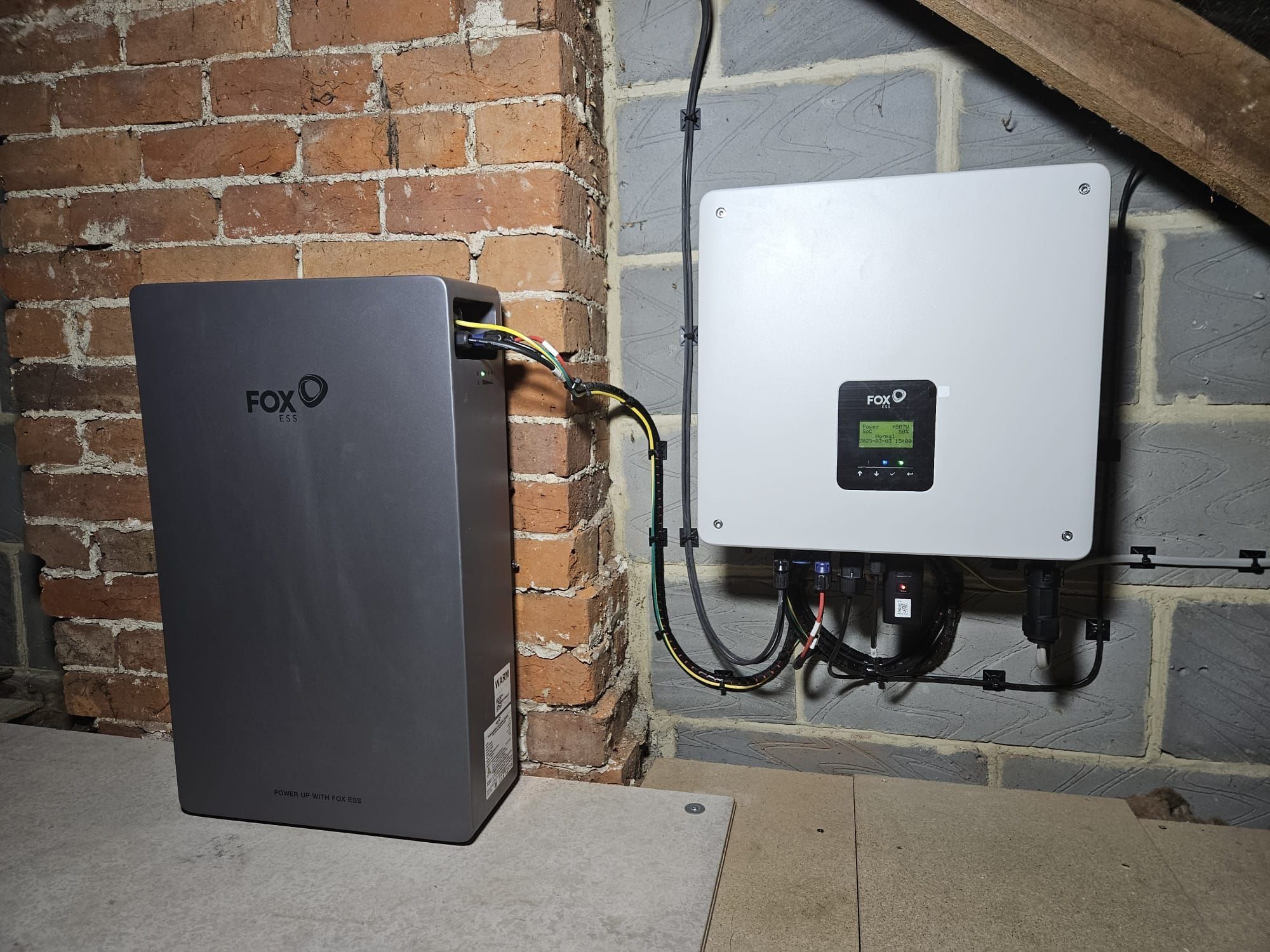
Our published installation photograph shows a Fox ESS battery paired with a Fox ESS inverter, wall-mounted, wired and running on an internal wall, with the isolators within reach beneath them. That is the strongest form of evidence anywhere on this site — not a logo on a page, but one of our own installations. Everything below is written from that starting point rather than from a brochure.
Ask any installer for a photograph of their own
It is the cheapest test there is, and very few websites pass it. Manufacturer renders, stock libraries and logo walls are available to anybody with a card; a photograph of your own work, on a real wall, is not. If a quote arrives without one, ask for one — and ask whose job it was.
Battery and inverter from one maker
Matching the battery to the inverter from a single manufacturer keeps the communication between the two simple and the fault-finding simpler still. When something misbehaves there is one app, one firmware line and one technical department, rather than two suppliers each politely suggesting it is the other one. It is a large part of why installers standardise on a line at all.
Where it actually lives on a Sussex house
A battery is a heavy object that wants a cool, dry, frost-free wall it can be fixed to properly, reasonably close to the consumer unit and reachable without moving a freezer. On the houses round here that usually means a garage, a utility, a boot room or a plant wall in an outbuilding. Lofts are possible and are very rarely the right answer — heat in July, cold in January, and a service visit that starts with a ladder.
The wall is a survey question, not a catalogue one
What the wall is made of decides how the unit is fixed: solid brick and blockwork are straightforward, a dot-and-dab plasterboard skin over a cavity is not, and a stud partition is a conversation before anyone drills. We look at that on the survey, along with where the cable run from the board is going to go and whether the route crosses anything you would rather it did not.
Retrofit, or designed in from the start
If the panels are already up, storage gets added to a system that exists — which can mean the existing inverter stays and the battery brings its own, or it can mean replacing the inverter so one unit handles both. Both are normal. Which is better on your house depends on the age and type of what is already fitted, and it is genuinely cheaper to answer that with a look than a phone call.
Doing it in one visit is the cheaper version
Where solar and storage go in together, the scaffold, the cable runs, the board work and the notification to your network operator all happen once. Splitting them across two years means paying for parts of that twice. If the budget only stretches to the array now, say so at the survey — we can leave the installation ready for a battery instead of leaving you to discover later that it is not.
The day itself, where storage is involved
Adding a battery means work at the consumer unit, so the power goes off for part of it. We tell you roughly when and for how long before we start rather than once the freezer is warming up, and on most houses it is a portion of the day rather than the whole of it. The unit gets mounted and connected, the protective devices go in, the circuit is tested, and nothing is left live until it has been.
What to ask us before you settle on it
Ask why this line and not one of the other three, and expect an answer about your house rather than about the brand. Ask where the units are going and what will be visible. Ask what the arrangement does when the grid goes off, because the honest answer differs by system and it is better heard now than during a power cut. Ask who you ring if it stops working, and who holds the paperwork.
Living with it, once the van has gone
Day to day, a battery is something you look at rather than something you operate. There is an app, it shows what the roof made, what the house used and what went to the grid, and after the first fortnight most people stop watching it. What is worth doing is glancing at it when a bill looks wrong — a system generating noticeably less than it did last spring is telling you something useful.
If it ever needs attention
You ring us, not a call centre. We fitted it, we hold the electrical certification for the circuit it sits on, and we would sooner come and look at it than try to diagnose a fault down a phone line. Where something has to go back to the manufacturer, that is a conversation we have with them on your behalf rather than one we hand to you.
What is actually in that photograph
A logo proves a relationship with a manufacturer. A finished job proves the work. This is the second kind, so it is worth going through what it shows rather than letting it sit there looking tidy.
-
A battery and an inverter carrying the same mark
Both units in the picture are Fox ESS. Matched from one maker, which is the arrangement that keeps the communication between them simple and the fault-finding simpler.
-
Mounted on an internal brick wall
Not a plant room and not a cupboard improvised around it — the usual UK domestic retrofit answer, where a garage or a utility has a wall that will take the weight.
-
Isolators alongside, where a hand can reach them
The switchgear sits beside the units rather than behind them. It is the difference between an installation and an installation somebody has to dismantle to work on.
-
Running, not just mounted
The photograph is one of our own installations, with the inverter live on the wall. It went on our own website as our work, which is why this line leads the page — the rest of it is here.
No badge for this one, and we are not going to invent one
Fox ESS is kit we fit. We do not hold it out as an accreditation, because it is not one — what we have instead is our own installation photograph with both units on the wall, which is a harder thing to fake than a logo.
See the rest of the work · How we separate approvals from kit we fit · Everything we're registered with
Charging an electric car off your own roof
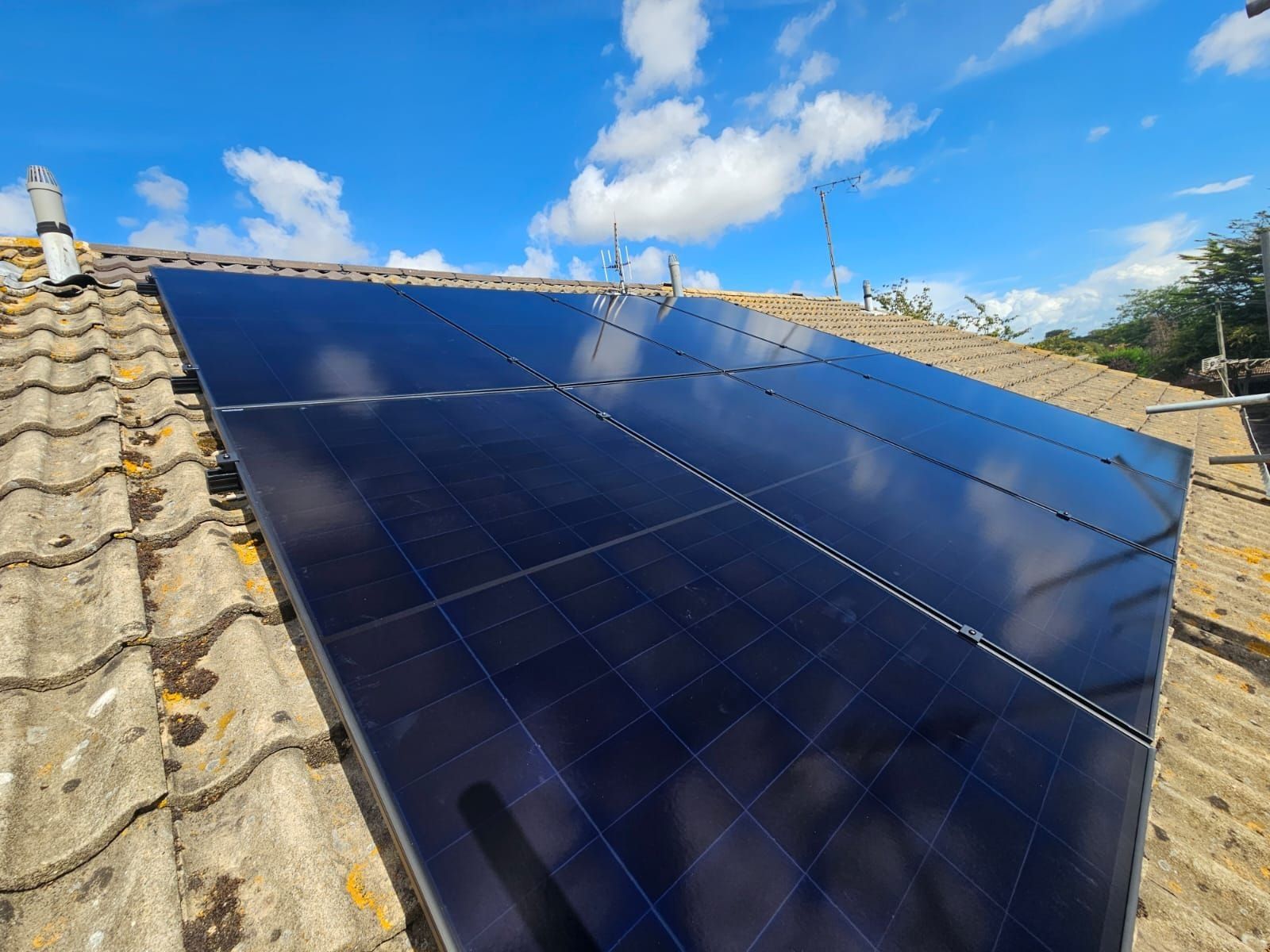
Pairing a home charger with solar changes the maths on both. What actually gets charged by the sun, and why the two want designing together.
Read it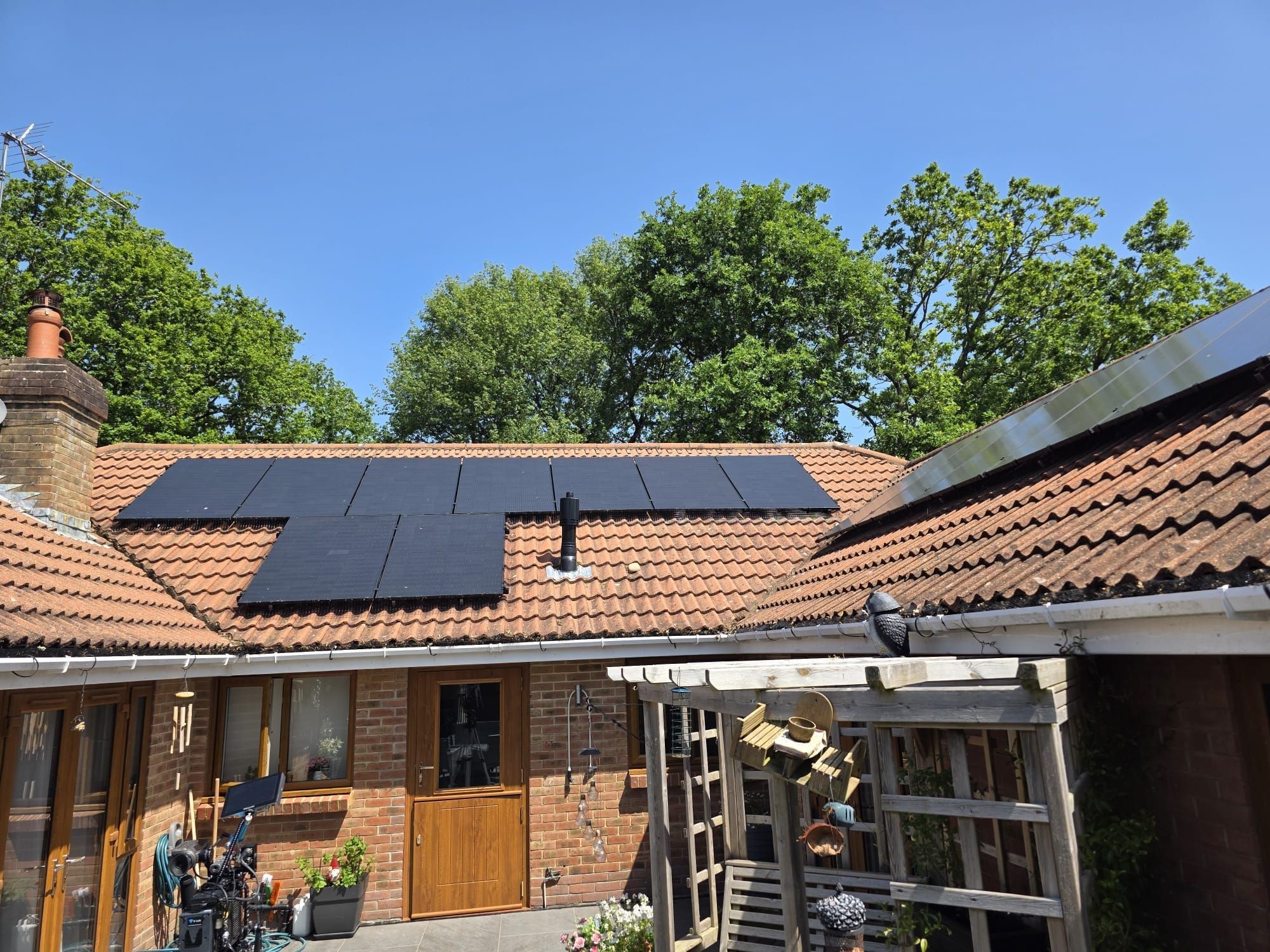
Zero VAT and the Smart Export Guarantee, explained plainly
The two schemes that actually affect what a domestic solar system costs and earns in the UK — what each one is, and what neither of them is.
Read it
What solar actually does in a Sussex winter
Panels still generate on grey days — just less. What a West Sussex December really looks like on the app, and how to make the short days count.
Read itWhat people ask at this point.
Do I need a battery?
Not necessarily. You can still benefit from solar panels without one, especially if you’re home during the day. But adding a battery means you can use your own power in the evenings or during load shedding, and avoid buying electricity at peak rates.
How do you decide which battery or inverter goes on my wall?
At the survey, on the shape of your system and where the equipment has to live — not before we have seen it. Your consumption pattern, the space available, and what the rest of the system is doing all bear on it.
The lines we fit are Hanchu ESS, Fox ESS, Sigenergy and EcoFlow — Fox being the battery and the inverter in our own installation photograph, and EcoFlow meaning their PowerOcean system, which can begin with one battery pack and grow. Separately from that, one manufacturer has approved us as an installer — SolaX Power — and that mark is on our accreditation wall. Being approved by a maker and fitting a line are still two different things, and we do not claim a badge we have not been given — none of the four lines we fit is shown as an approval. Which equipment lands on your wall is a decision that comes out of the visit, and we will tell you why.
How long does a solar installation take?
Most domestic systems are installed in 1–2 days. Bigger or more complex systems might take a little longer. We’ll go over the full timeline during your site survey.
Read all the questions — or ask yours at the free survey.
The next step
Book your free survey
Thirty to forty-five minutes, at your house, at no cost. We look at the roof, the fuse board and how you actually use the place — then send you a clear quote with the assumptions shown.
- Call 01243 882444
- Email hello@solar-squirrel.co.uk
- Based Washington, West Sussex
If solar genuinely won’t pay for itself on your usage, we’ll say so and save us both an afternoon.
Rather see the numbers before you speak to anybody? Put your own bill on the house — it works out the size, the saving and the payback while you watch, and brings them down to this form with you.