

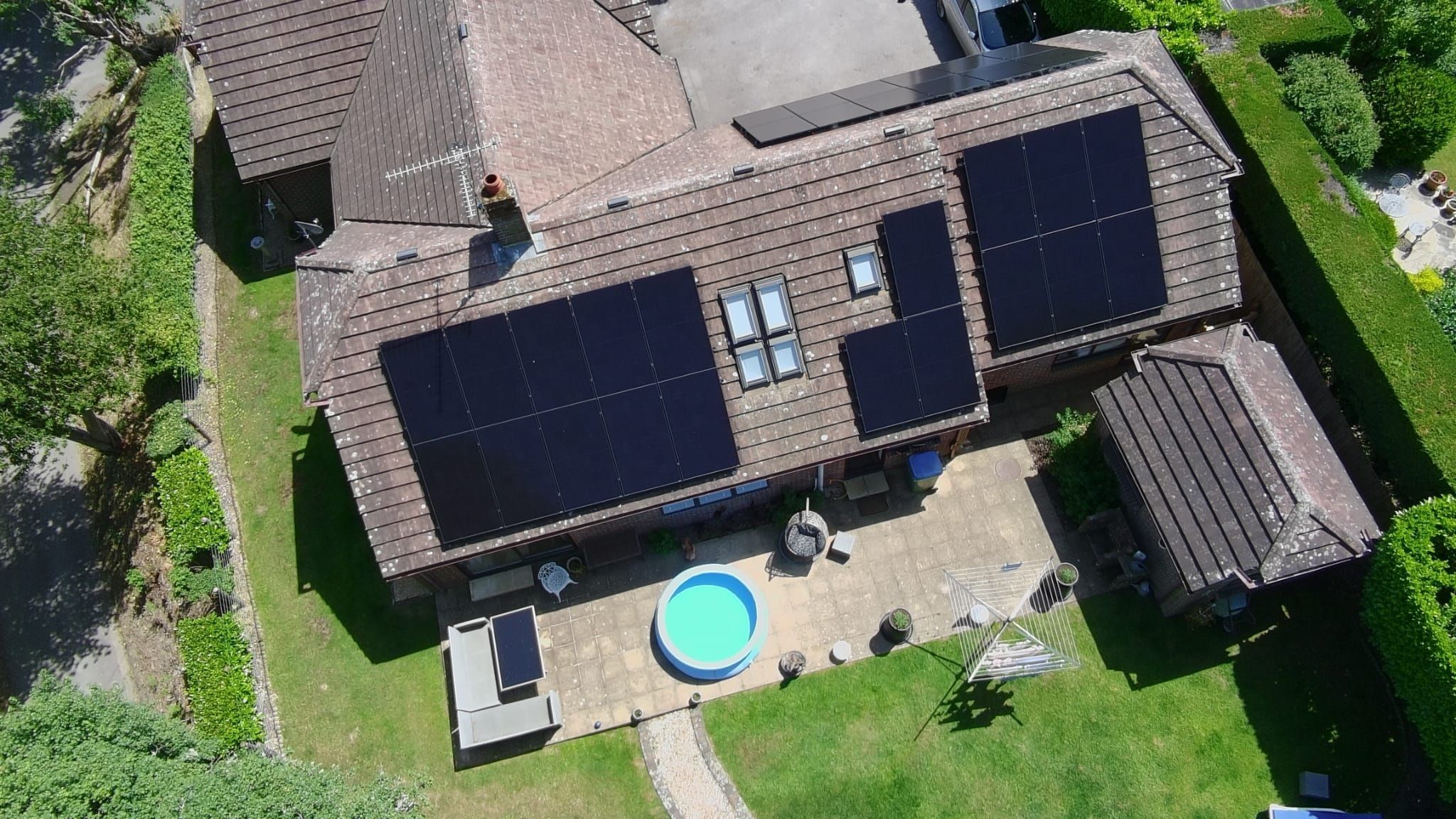
Solar savings calculator
Work out what solar would save on your roof.
Put your own monthly bill on the house below, switch a battery or an EV charger on, and the system size, the yearly saving and the payback all move with it. No email needed to see a number.
Your bill, on this roof
Put it on the house. Then read the numbers.
Tell it what you pay and which way your roof faces, then switch things on. Every constant is disclosed below — nothing here is a sales target.
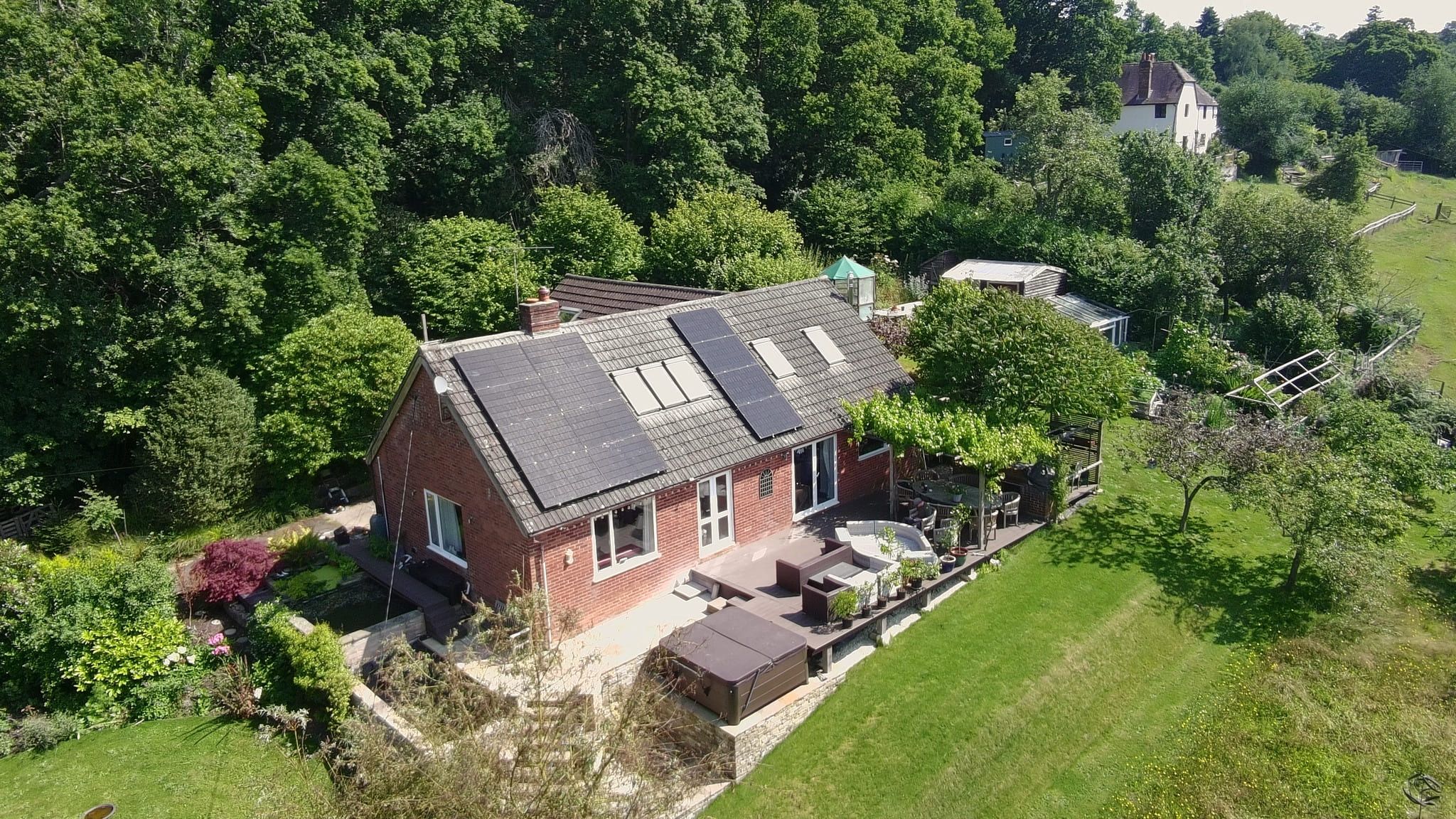
Your house
Which way it faces
The house is drawn as it stands; the bronze plate on the lawn shows the way you have picked.
Due south. The best case, and the one every other figure here is measured against.
What goes on it
What it’s worth
Off your own roof
29%
System size
~5.0 kWp
Indicative cost
~£8,600
Pays for itself
~12 yrs
CO₂ avoided a year
~870 kg
Crosses the cost line at about 12 years.
~£17,100 by year 25 — ~£8,500 clear of the system cost
A battery moves 1,045 units a year from the sold pile to the kept pile — about £137. It also costs £4,600, and on these numbers that pushes payback from about 12 years to about 16 years. We’d rather you knew that before we quoted.
The array on the house is a drawing of a system, not a count of your panels — how many, and where they go, is what the survey is for. The size that moves with your answers is the kWp figure above. Solar Squirrel’s own published guidance is that “£300–£600 per year” is the average UK household saving, with their own caveats attached. The figures above are a design preview worked from the constants below — not a quote, and not a guarantee.
Every assumption behind this number
Nothing here is hidden, because a number you can’t interrogate isn’t worth having. These are the exact constants the instrument above uses:
- Electricity unit rate
- 0.2611 £/kWh
- Standing charge
- £220 a year, removed before usage is worked out
- Export rate (SEG)
- 0.13 £/kWh for anything you don’t use — a flat rate, held all day. This does not model time-of-use tariffs, which is where a battery usually earns its keep.
- System sizing
- 1 kWp of panels per 950 kWh of annual use, held between 2.5 and 9 kWp for a house. This is the step that fixes the size, so it fixes the cost and the payback too.
- Annual yield
- 857 kWh per kWp, South East England
- Roof direction factor
- South 1.00 · SE/SW 0.94 · E/W 0.83 · North 0.62
- Self-use without a battery
- 48% ceiling
- Self-use with a battery
- 85% ceiling
- Indicative system cost
- £6,100 is the basis for a 3.5 kWp system, and the cost scales linearly with size from there. This is a modelled figure and it sits a little above the “£4,000 to £6,000” we publish as a typical starting point — your own price comes from the survey, not from this.
- Battery cost
- £4,600 added when the battery is on
- Electric car
- adds 1,800 kWh a year to consumption
- Panel degradation
- 0.5% a year across the 25-year view
- Carbon factor
- 0.207 kg CO₂ per kWh displaced — this counts everything the roof generates, used or exported, which is why it doesn’t move when the battery does.
The maths: annual usage is your bill less the standing charge, divided by the unit rate. System size is that usage divided by 950 and held between 2.5 and 9 kWp. Generation is system size × yield × roof factor. The share you actually use yourself follows a saturating curve capped at the ceilings above; the rest is exported at the SEG rate. Payback is the interpolated point where the cumulative saving crosses the system cost.
Representative figures for a design preview. Solar Squirrel’s own published guidance is that most domestic installations “£4,000 to £6,000” to start, and that “£300–£600 per year” is the average UK household saving — with their own caveats attached. This tool is not a quote and not a guarantee.
What a solar panel cost calculator can tell you, and what it cannot
A solar panel cost calculator is a model, and this one is honest about being one. It takes the bill you type in, works back to a yearly consumption, sizes an array to that consumption and the roof type you pick, and applies published assumptions for yield, self-use and the price of a unit. Every constant it uses is printed on this page. What it cannot know is your roof: its pitch, its orientation, the shading at four o’clock in December, the state of the battens, how far the consumer unit is from the loft, and whether the scaffold is a simple lift or a street-licence job. Those are the things that move a real quote, and they are what the free survey is for.
Where the typical UK figures come from
If you want a national yardstick to hold a quote against, use the Energy Saving Trust rather than an installer. Its solar advice page, read on 6 October 2026, puts the cost of an average home solar panel system at around £7,600 to install, describes a 4.5 kWp system as typically covering 20 to 30 square metres of roof with around twelve panels, and publishes a city-by-city payback table based on July 2026 fuel prices. Treat those as the centre of the range, not a price: a West Sussex job with a battery, bird mesh and a two-storey scaffold sits above it, and a straightforward bungalow roof with a short cable run can sit below it.
What moves the installed price on a West Sussex roof
- Access. Scaffold is the biggest single variable after the equipment, and it is always in our quote rather than arriving as an extra.
- The covering. Clay peg tile, slate and especially Horsham stone take longer and need different fixings than modern concrete tile.
- A battery. It changes the inverter, the wall, the cable runs and, since April 2026, the regulations that govern where it can go.
- The electrics. An old consumer unit or a long run from loft to board can add a day.
- Bird mesh and coastal fixings. Cheap on the day the scaffold is up, expensive as a return visit.
The calculator above cannot see any of that, which is exactly why the number it gives you is a starting point for a conversation and not the quote. The quote comes after someone has stood on your drive and looked up.
The people who fitted them.
The figures above come from the same model we quote from. These are the customers who had the work done, in their own words, copied from Google.
-
Had 12 panels installed. Young apprentice was brilliant and did most of the cabling. Superb. Charlie was a delight to do business with and cant hesitate to recommend them. Top Class.
Colin E.
Read in full on Google (opens in a new tab) -
I have absolutely nothing negative to say about this company. Everything Gareth said they would do in the initial meetings, they have delivered on perfectly and on time. We had Charlie & Declan on site, they were both polite and tidy but were also personable which made having people working in our home so much easier. Since it has been fitted, they have been really good at staying in contact and setting the systems up. It also did not go unnoticed that the other company they brought in for scaffolding were also really efficient, clean, tidy and friendly and they took it away quickly after. I would highly recommend Solar Squirrel.
Corinne W.
Read in full on Google (opens in a new tab) -
Absolutely delighted that I chose Solar Squirrel. I received great advice from Gareth about our Solar System before we chose them to instal our system. Their quote included everything and was very competitive. The installation was completed very quickly in 3 days and to a very high standard. The team were very customer focused and really pleasant and helpful to deal with. The Solar system worked immediately it was installed with no issues. My App showed all the information about our electric generation and our usage. Gareth returned a week after the installation to show me how to start the process of selling back electricity to the grid. Our electric bill was £3 a day. Now 5 pence. Once we start selling back electric to the Grid I expect a further £3 per day generation during the Summer months. I have already started recommending neighbours to talk to Solar Squirrel if they are looking to install Solar. I have nothing but praise for this Company. Murray
Murray C.
Read in full on Google (opens in a new tab) -
Highly professional, from start to finish, nothing was too much trouble excellent service would recommend this quality service,if you are looking for solar panels to be fitted.
Neil B.
Read in full on Google (opens in a new tab) -
Excellent service and they care about their customers. Would highly recommend!!
Kristy K.
Read in full on Google (opens in a new tab) -
A+++ great all around service from Gareth.
Joe R.
Read in full on Google (opens in a new tab) -
Fantastic comprehensive service from Charlie and Gareth, from calling to quote to install completion. Full system including 16 panels, 9.4kw hybrid system. Having previously used their sister company Edmonds Electrical for general electrical work. Would highly recommend to anyone looking for a competitive price on a solar installation. Will be strongly considering a system for commercial use.
Neo
Read in full on Google (opens in a new tab) -
I can highly recommend Solar Squirrel if you’re looking to have solar fitted to your home, Gareth’s team are a great bunch of lads who work with great dedication, clean tidy with no fuss. I had ten panels and a 5:3 kw battery installed. All fitted beautifully straight and level, the hole job looks very tidy which is very important to me,
Alan D.
Read in full on Google (opens in a new tab)
Certified, registered, and accountable to somebody other than us.






Edmonds Electrical Ltd, company number 11631977, registered at Wayside, Chanctonbury Close, Washington, Pulborough, RH20 4AR. Trading as Solar Squirrel since 2018.
What people ask at this point.
The calculator gives you a realistic shape. These four answer what usually comes next — and none of them is a sales answer.
How much will I actually save with solar panels?
On average, UK homeowners save £300–£600 per year, sometimes more if you add battery storage or work from home during the day. Your savings depend on:
- Your energy usage
- System size
- Whether you use a battery or export energy
- Electricity prices in your area
How much does it cost to install solar panels in the UK?
The cost depends on the size of your home and the amount of energy you use, but most domestic solar panel installations in the UK typically start from around £4,000 to £6,000. If you add battery storage, that cost will go up, but so will your savings. We’ll give you a detailed, personalised quote during your free survey.
Do I need a battery?
Not necessarily. You can still benefit from solar panels without one, especially if you’re home during the day. But adding a battery means you can use your own power in the evenings or during load shedding, and avoid buying electricity at peak rates.
Do solar panels work in winter or on cloudy days?
Yes, they still generate power on overcast days, just less than in full sun. Battery storage can help you make the most of what you generate all year round.
Will there be scaffolding, and is it in the quote?
On a pitched roof, almost always yes. Scaffold goes up, the mounting system and panels go on, the electrical side gets tied in, and it comes down again once everything is tested.
Access is one of the assumptions the quote is written on, so what the scaffold involves is set out there rather than met for the first time on an invoice. If access is genuinely awkward — a narrow lane, a shared drive, a neighbour’s garden — that gets discussed at the survey, because it is easier to solve on paper than on the morning.
Does my electricity network operator need to be told?
Yes. A grid-connected system has to be registered with the local network operator, and so does a home charge point. For a typical domestic installation that is a notification we send after commissioning; a larger system can need an application before the work starts, which we would flag at design stage.
Either way it is our paperwork, not yours. You should not have to ring anybody.
Everything else is on the questions page, or ring 01243 882444 — you’ll get a person, first time.
The number for your actual roof
A calculator can only get you close.
The survey is where it gets exact: your roof, your shading, your usage, your consumer unit. It's free, it takes 30–45 minutes, and if your roof isn't worth doing we'll tell you that instead.
- Call 01243 882444
- Email hello@solar-squirrel.co.uk
- Based Washington, West Sussex
If solar genuinely won’t pay for itself on your usage, we’ll say so and save us both an afternoon.