

Modular battery storage
EcoFlow
EcoFlow is a line we fit, and what we fit from EcoFlow is PowerOcean — their hybrid inverter with battery packs, arranged so a system can start with a single pack and grow. Below is what that means on a real house, and what it leaves for you to decide.
No photograph on this page. We have not fitted one of these on a job we have photographed, and an array of ours with somebody else’s battery behind it would not be evidence of anything — nor would a render off the manufacturer’s website.
What PowerOcean actually is
Two parts, working as one system. The first is an EcoFlow hybrid inverter, which runs the solar panels and the battery together. The second is the battery itself: one or several lithium iron phosphate (LFP) packs, mounted on a wall or standing on the floor. EcoFlow make it in a single-phase version and in a version for houses with a three-phase supply.
A familiar name, and a different product
If the EcoFlow name rings a bell, it may well be from their portable power stations, which are a different kind of product. PowerOcean is a fixed home system: mounted at the house, wired into its electrics and tested by us like any other circuit we work on. EcoFlow sell both, so if you are comparing quotes, check which of the two a price is actually for.
Start with one pack, and add more later
EcoFlow designed PowerOcean so a system can begin with a single battery pack and take more later, each added pack working alongside the ones already fitted. That suits a household whose use is likely to change — an electric car, a heat pump — without anybody knowing quite when. One inverter takes only so many packs, and EcoFlow publish where that ceiling sits; we put it in writing against your house. When the day comes to add a pack, we check what EcoFlow sell then against what you already have.
What is inside each pack
Each pack carries its own battery management system, watching that pack’s cells and temperature and guarding against overcharging, deep discharging and overheating. EcoFlow build the packs to work independently of one another, with a fire prevention module designed to act if a battery overheats. That is EcoFlow’s description of their design, and we repeat it as theirs. What is ours is where the packs go, how they are fixed and how their circuit is protected.
Garages, outbuildings and the weather
The places with room for a battery are often unheated, so one detail matters more than it sounds: EcoFlow build heating pads into the packs for cold conditions. They also rate the casing as protected against dust and low-pressure water jets from any direction, and list the system for indoor or outdoor installation. That widens the places worth considering. It does not make the choice — the run back to the board, what is behind the wall and safe access still decide that, on the survey.
In a power cut, and what backup covers
PowerOcean’s inverter has a backup output. In a power cut, the circuits wired to it can keep running from the battery, within what the system can supply at once and while the charge lasts. Which circuits those are is decided before the installation — the fridge and freezer, some lights and the broadband are the usual start — so talk it through at the survey, not on the first dark evening. Keeping the whole house running is a different arrangement: on a single-phase supply it needs a separate EcoFlow unit, the Gateway.
Octopus tariffs, and who is steering the battery
EcoFlow’s app has a dynamic tariff dashboard that works with Octopus Energy’s Flux and Agile tariffs, showing the prices ahead so charging can be planned around them. EcoFlow have also announced an integration with Intelligent Octopus Flux for PowerOcean Single-Phase, under which Octopus take control of when the battery charges and discharges. That is convenient, and it is also a handover: the battery then follows Octopus’s decisions rather than a schedule you set. Which tariff you can get is between you and your supplier.
What you see, and the half you do not
You follow PowerOcean through EcoFlow’s app or their web portal: solar coming in, the house drawing power, the battery charging or giving it back. EcoFlow update its software remotely, over the air, so it keeps receiving their changes after we have left. There is also a separate installer version of the app and portal, where a system is commissioned and its error codes are sorted by urgency — the half you never see, and the half that matters when something needs looking at.
A house that already has panels
Plenty of the houses we are asked about already have panels and an inverter. PowerOcean is built around EcoFlow’s own hybrid inverter, so on a house like that the first question is not the battery — it is what happens to the inverter you already own. That depends on its age, its type and what is connected to it, and we answer it after looking at the unit, in writing. If PowerOcean is the wrong fit for what is there, you will hear that too, with what we would suggest instead.
The numbers EcoFlow publish, and why they are not here
EcoFlow publish plenty of figures for PowerOcean — how much each pack holds, what the system can supply at once, how long the warranty runs and on what conditions. None of them is on this page: they are EcoFlow’s, they get revised, and a number copied onto an installer’s website tends to outlive the product it described. You get the current datasheet and warranty terms for the exact configuration we propose, with the quote, and we go through the conditions before you sign.
Next to the other three lines
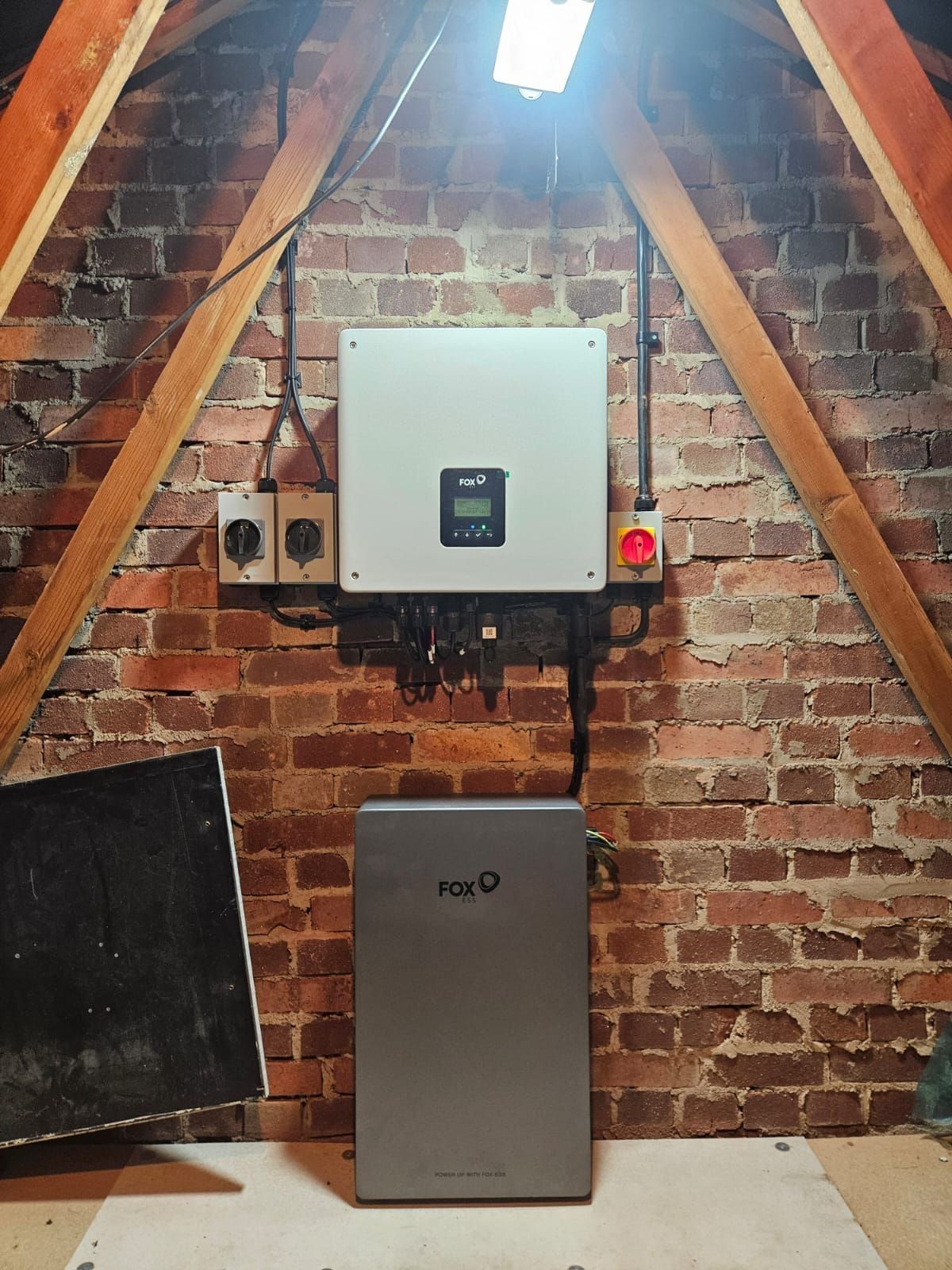
Of the other three, Hanchu ESS is the less familiar name that earns its place on the right building, Fox ESS is the one our own installation photograph shows, and Sigenergy puts the inverter, the battery and, if it suits, the car charger in one assembly. PowerOcean is worth a look if you would like to begin small and build the battery up, or want it run around an Octopus tariff — reasons to consider it, not reasons to rule the others out. Choosing between the four is the survey’s job.
What a home battery is actually for
So here is a drawing instead. It carries no badge, because the point of it is the part that is the same whichever line ends up on your wall.
What it does is the same whatever the badge on the front says. Daylight goes in while nobody is home to use it, and comes back out at six o'clock when everybody is. Without one, the surplus goes to the grid and you buy it back later at a worse rate.
Whether you want one at all is a real question and the answer is sometimes no — if you are home through the middle of the day you may already be using most of what the roof makes. How storage behaves day to day covers it, and the questions people ask first include that one.
Our own drawing of a housed home battery — not a photograph, and not EcoFlow hardware. The unit proposed for your house is named at the survey.
Is a battery worth it? The honest arithmetic
A battery roughly doubles how much of your own generation you use. Whether that pays depends on when your house is empty. Here is the arithmetic.
Read it
Zero VAT and the Smart Export Guarantee, explained plainly
The two schemes that actually affect what a domestic solar system costs and earns in the UK — what each one is, and what neither of them is.
Read it
What solar actually does in a Sussex winter
Panels still generate on grey days — just less. What a West Sussex December really looks like on the app, and how to make the short days count.
Read itWhat people ask at this point.
What happens during the free survey?
We visit your home (or site), check your roof space, electrical setup, and talk through your energy use. It usually takes 30–45 minutes. After that, we’ll send you a clear, no-pressure quote.
What maintenance do solar panels need?
Very little, which is the honest answer and not a sales one. There is nothing on a domestic array that needs servicing on a schedule the way a boiler does.
Rain does most of the cleaning on a normal pitch. What is worth doing is glancing at the monitoring app now and then — a system that is generating noticeably less than it did is telling you something, and it is far easier to look at in spring than in December. Where a roof is prone to pigeons we fit mesh along the perimeter as part of the original job, because clearing a nest out later costs more than preventing it.
Do you only do solar, or general electrical jobs too?
Both. Consumer unit changes, additional circuits, outdoor sockets and lighting, fault-finding on a circuit that trips for no obvious reason, and the tidying-up that follows somebody else’s weekend project.
You do not need to be a solar customer to ring us about a fuse board, and the certification is the same whether it is a full array or a single socket.
Read all the questions — or ask yours at the free survey.
The next step
Book your free survey
Thirty to forty-five minutes, at your house, at no cost. We look at the roof, the fuse board and how you actually use the place — then send you a clear quote with the assumptions shown.
- Call 01243 882444
- Email hello@solar-squirrel.co.uk
- Based Washington, West Sussex
If solar genuinely won’t pay for itself on your usage, we’ll say so and save us both an afternoon.
Rather see the numbers before you speak to anybody? Put your own bill on the house — it works out the size, the saving and the payback while you watch, and brings them down to this form with you.