

EV charging
EV charger installation in Surrey: the rollout, the cable-gully rule and what a home charger needs
What Surrey has built and banned — 200-plus public sockets, no cables across the pavement — and what a home charger on the Surrey edge involves.
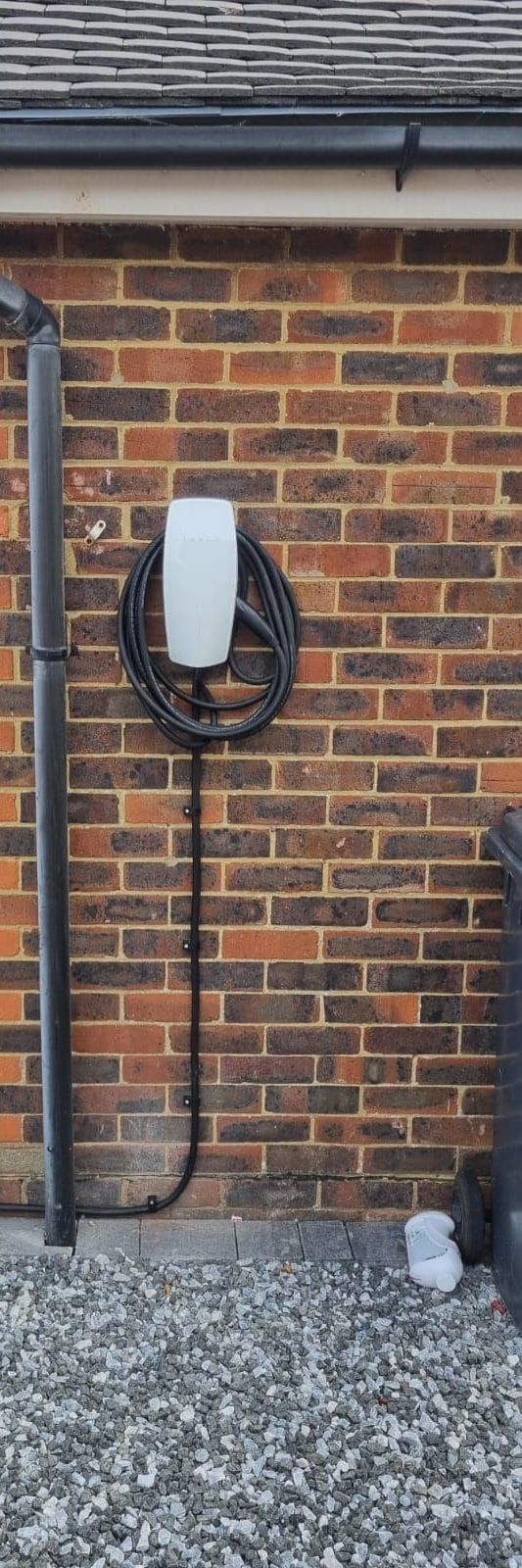
A tethered charger on a brick wall beside a gravel drive, from one of our own installations. The drive is the whole point: in Surrey, no drive means no home charger.
The part of Surrey we cover — Cranleigh, Haslemere, Dorking and Horley, with Reigate on our thirty-mile line — is the one county on our patch that has written its charging rules down in plain terms. That makes it the clearest place to explain the two halves of the question: what the county provides for a house without a drive, and what a home charger involves for a house with one.
What the county has built
Surrey County Council’s own page, reviewed on 1 October 2026, reports over 200 EV chargepoint sockets installed on its behalf by October 2024, under a contract signed with Connected Kerb in February 2023 covering chargepoints across the following five years — “thousands” is the council’s word for the scale. The kit comes in three kinds: standard 7 kW units, slower 3–5 kW lamp-post units where a bollard is not feasible, and rapid 50 kW-plus units mostly in car parks. Residents can request an on-street location through an interactive map on Commonplace, and the council says locations are chosen where residents have asked, where public access is lacking and where many homes have no off-street parking.
What the county has banned
The same page is explicit: trailing a cable across the pavement is not allowed in Surrey, and EV charging cables are only permitted to cross a public footpath if they are safely enclosed in a cable gully. That one sentence settles the question for a terrace with on-street parking. A home charger needs your own off-street space; without one, the public network and the request map are the route, and a cable protector across the footway is not a workaround.
What a home charger needs
A space that is yours. A drive, a garage, a space off a lane with vehicle access. The unit goes on the wall nearest where the car actually stops, which is not always the obvious wall.
A board that can take it. A charging point is a dedicated circuit with the right protection at the consumer unit. A modern board usually has a spare way; an older one may need work first, and that is quoted as its own line so you can see which is which.
A supply that can take it. A charger, an oven and a shower running at once is more than plenty of older supplies enjoy. A load-managed charger watches the incoming supply and eases off rather than tripping the main fuse — which matters more in an older Surrey house than in a new build.
A notification. The charging point is reported to the network operator, and on the Surrey edge that is two different companies: UK Power Networks for Cranleigh, Dorking, Horley and Reigate, Scottish and Southern for Haslemere and Godalming. We read which from the MPAN on your bill, because the boundary wanders, and we make the notification as part of the job with the certificate.
The grant, and who it is for
The government’s chargepoint grant covers 75% of the cost of buying and installing a socket, up to £500, for people who own a flat or rent a residential property — provided the home has its own private off-street parking space and the vehicle is on the OZEV-approved list (gov.uk, read 19 October 2026). Owner-occupiers of houses are not covered; a tenant with a drive is.
The car changes the solar and the battery
A 7 kW charger draws more than a domestic array makes at its best moment, and most cars charge at night, so the panels do not charge the car directly; what the car does is add the largest single load the house will ever carry — our model allows 1,800 kWh a year — and change the size of everything else. On the Surrey edge, where the modelled yield is below the coast’s, that is the argument for a battery sized to the evening load and a cheap-rate overnight tariff for the car. Solar, a battery and an electric car, sized as one system is the method; export tariffs compared lists the overnight tariffs, dated.
Where to go next
EV charger installation in Surrey is the page for the job and EV chargers in Dorking the town page; solar panels in Surrey and battery storage in Surrey are the other two parts of the design; G98 or G99 explained is the paperwork for the inverter, which is separate from the charger’s. The words — load-managed charger, time-of-use tariff — are in the glossary.
Sources: Surrey County Council, “Electric vehicles and our on-street chargepoint rollout” (reviewed 1 October 2026); gov.uk, “Electric vehicle chargepoint grant for renters or flat owners” (read 19 October 2026); the site’s own EV-charger and estimator figures.
More from the blog
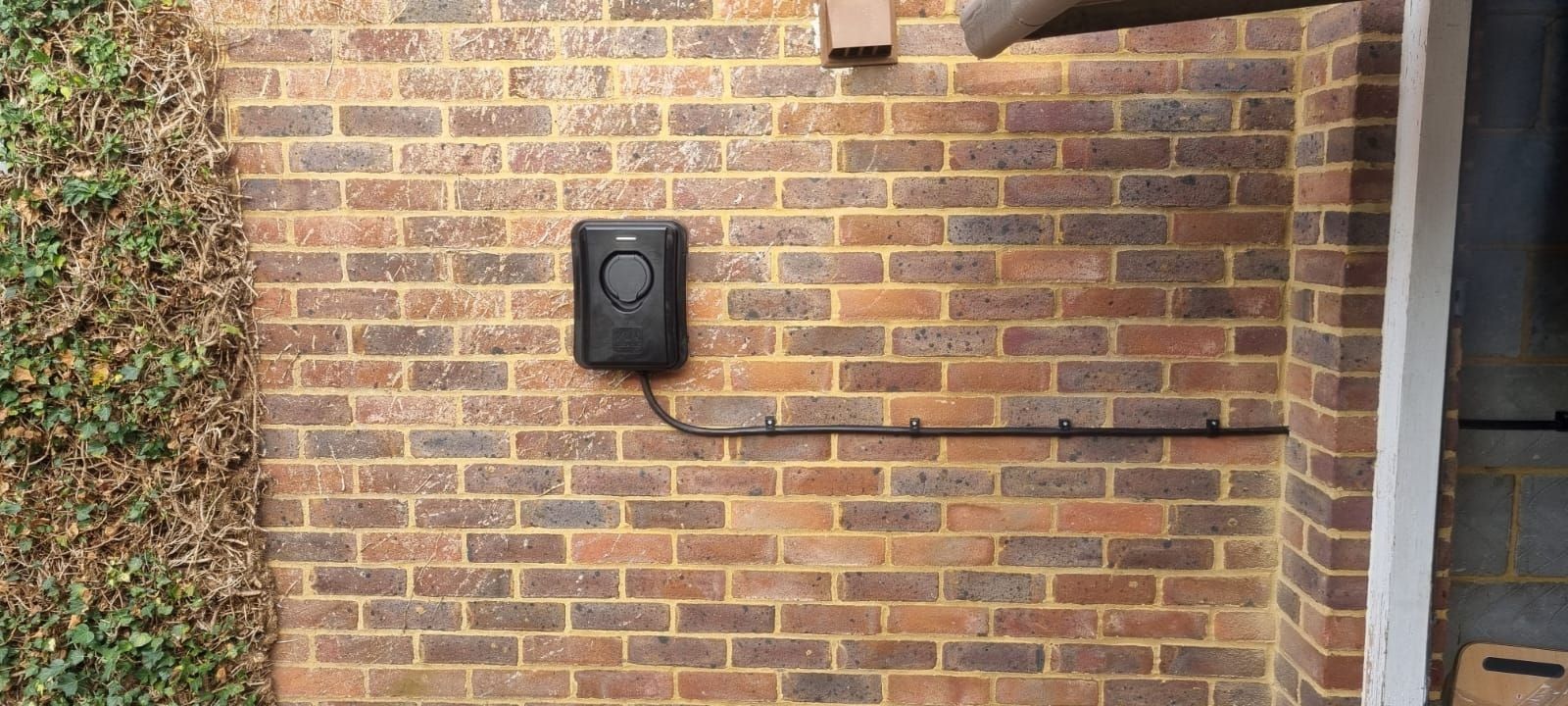
Charging an electric car in a Brighton terrace: the public network, and the home-charger cases
Over 1,000 public chargepoints, 86% of residents without off-street parking within a three-minute walk — and when a Brighton house can have its own.
Read it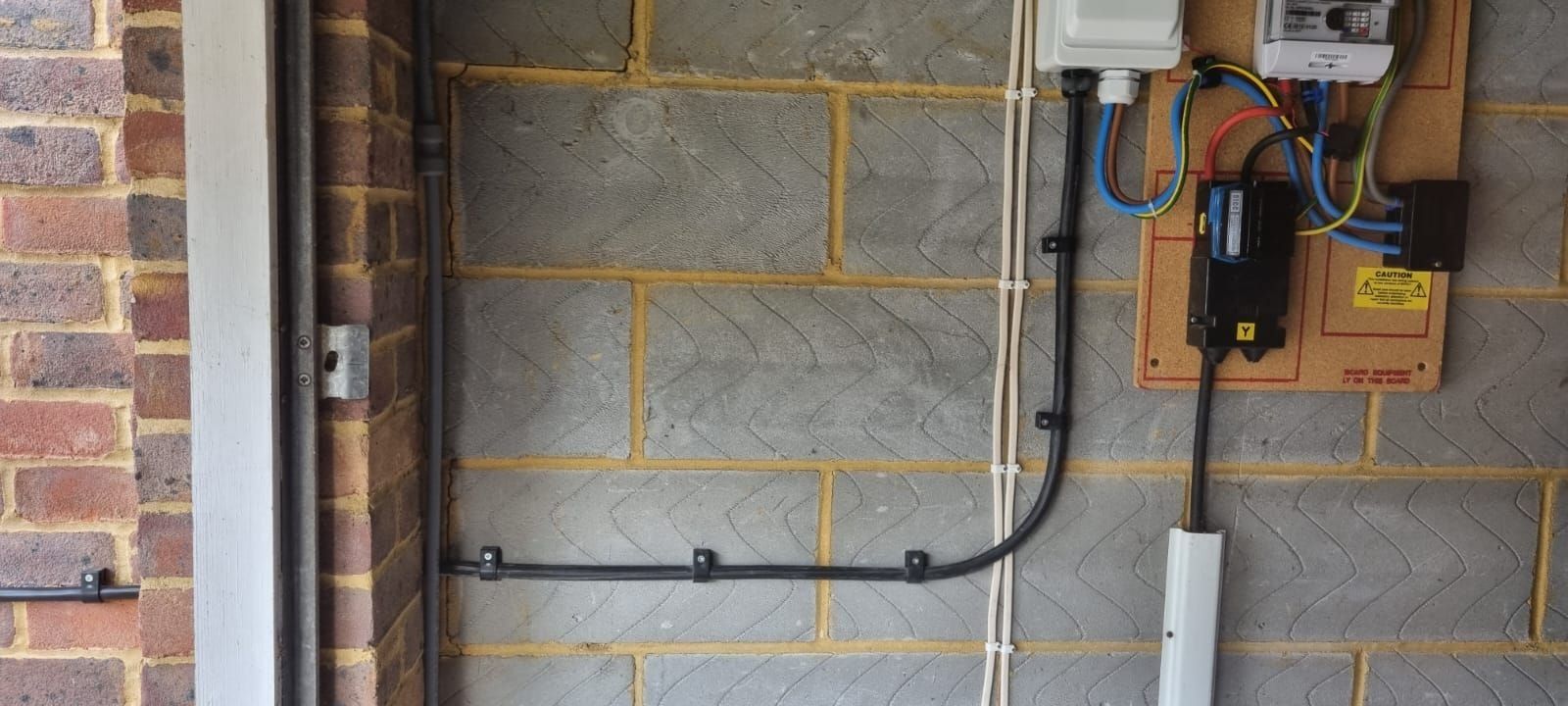
A home charger in a Worthing terrace: parking, the supply and the grant
Three Worthing houses — a semi with a drive, a terrace with a rear space, a terrace on the street — and what each can do about charging a car at home.
Read it
Where we fit EcoFlow PowerOcean across Sussex and Surrey: one pack, and the places it can grow
EcoFlow PowerOcean county by county: one pack on a West Sussex estate, a shaded Surrey roof, the unheated clifftop garages, the Solar Together roofs.
Read it