

EV charging
Solar, a battery and an electric car: sizing the three as one system
Cars charge at night and a 7 kW charger out-draws a domestic array: how we size the array, battery and charger as one system, and the tariffs that change.
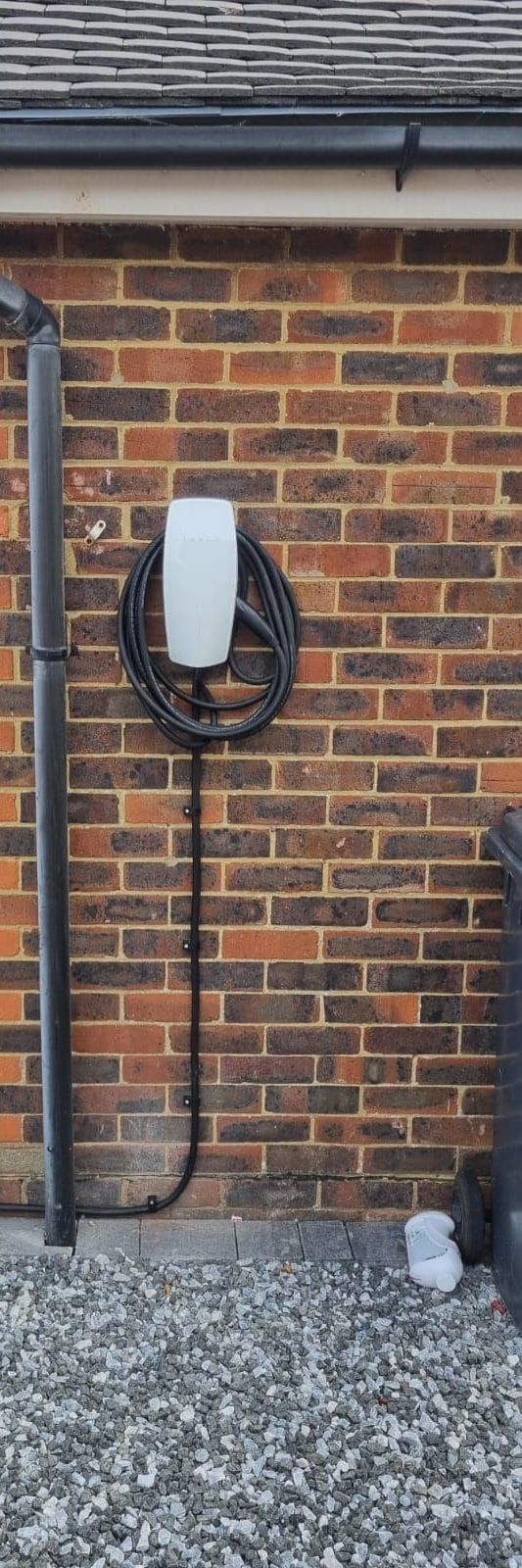
A tethered charger on a brick wall beside a gravel drive, from one of our own installations. It is the largest single load most houses will ever add, and it changes the size of everything else.
People ask whether their solar will charge the car. The honest answer starts with two facts and then gets more useful. A 7 kW home charger draws more than a typical domestic array produces at its very best moment, and most people charge overnight, when there is no sun at all. So the panels do not charge the car directly, most of the time. What they can do is change the economics of the whole house, if the three pieces are sized as one system rather than bought in sequence.
The car’s number
Our model allows 1,800 kWh a year for an electric car — the extra electricity a house draws once a car is plugged in regularly. That is the single largest load most houses on our patch will ever add, and it is why a system sized before the car arrives is the wrong system for the house that has one. If a car is on the horizon at all, say so at the survey.
What the array does, and what it does not
The array covers the house. Sized from your bill — annual kWh, the roof’s yield and orientation, the shade — it makes most of its electricity in the middle of the day. Add 1,800 kWh of car to the annual total and the array can be sized to cover more of it, but the car still charges at night, so the array’s contribution to the car is indirect: it covers the house by day so the house buys less, and the surplus either goes to a battery or out to the grid at the export rate.
What the battery does
Two things, and they pull in different directions. It can fill during the day and discharge into the car overnight — a battery sized to do that is a larger battery than one sized to the evening load alone, and the survey has to know which job it is for. Or, on a cheap-rate tariff, it can do the opposite: charge from the grid in the cheap window alongside the car, and release that electricity into the expensive part of the day. Which of those makes sense depends on the tariff, which is the next number.
The tariff the car changes
With a car, a tariff with a cheap overnight window is usually the first thing to look at. As of our tariff reference (June 2026, verified August 2026), Intelligent Octopus Go offered around 7p per kWh in a roughly six-hour overnight smart window and E.ON Next Drive around 8p between midnight and six; against an import rate of about 26p and an export rate of 12p, the sensible play is often to charge the car on the cheap rate and use the solar for the house during the day. The current rows are on export tariffs compared, dated.
The charger is its own job
A charging point is a dedicated circuit, the right protection at the board and a notification to the network operator before it is anything else. A charger, an oven and a shower running at once is more than plenty of older supplies enjoy, which is why a load-managed charger — one that watches the incoming supply and eases off rather than tripping the main fuse — matters more in an older Sussex property than in a new build. The inverter rating is what decides whether the solar side is a G98 notification or a G99 application; the charger is notified separately. Both are done by us, with the certificate.
Designed once, not three times
Array to the house plus the car’s share; battery to the job you want it to do; charger to the supply the house has; tariff to the three of them. Retrofitting any one of those later costs more than designing it in, which is also the argument for a battery line that can be added to, such as a stacked assembly that puts the charger in the same unit.
Where to go next
Solar and an electric car is the shorter version; sizing a system from your bill is the five numbers; G98 or G99 explained is the paperwork; EV charger installation is the charger side; and battery, EV and a Horsham estate house works a typical case through. The terms — load-managed charger, time-of-use tariff, self-consumption — are in the glossary.
More from the blog
Charging an electric car in a Brighton terrace: the public network, and the home-charger cases
Over 1,000 public chargepoints, 86% of residents without off-street parking within a three-minute walk — and when a Brighton house can have its own.
Read it EV charger installation in Surrey: the rollout, the cable-gully rule and what a home charger needs
What Surrey has built and banned — 200-plus public sockets, no cables across the pavement — and what a home charger on the Surrey edge involves.
Read it
A home charger in a Worthing terrace: parking, the supply and the grant
Three Worthing houses — a semi with a drive, a terrace with a rear space, a terrace on the street — and what each can do about charging a car at home.
Read it