

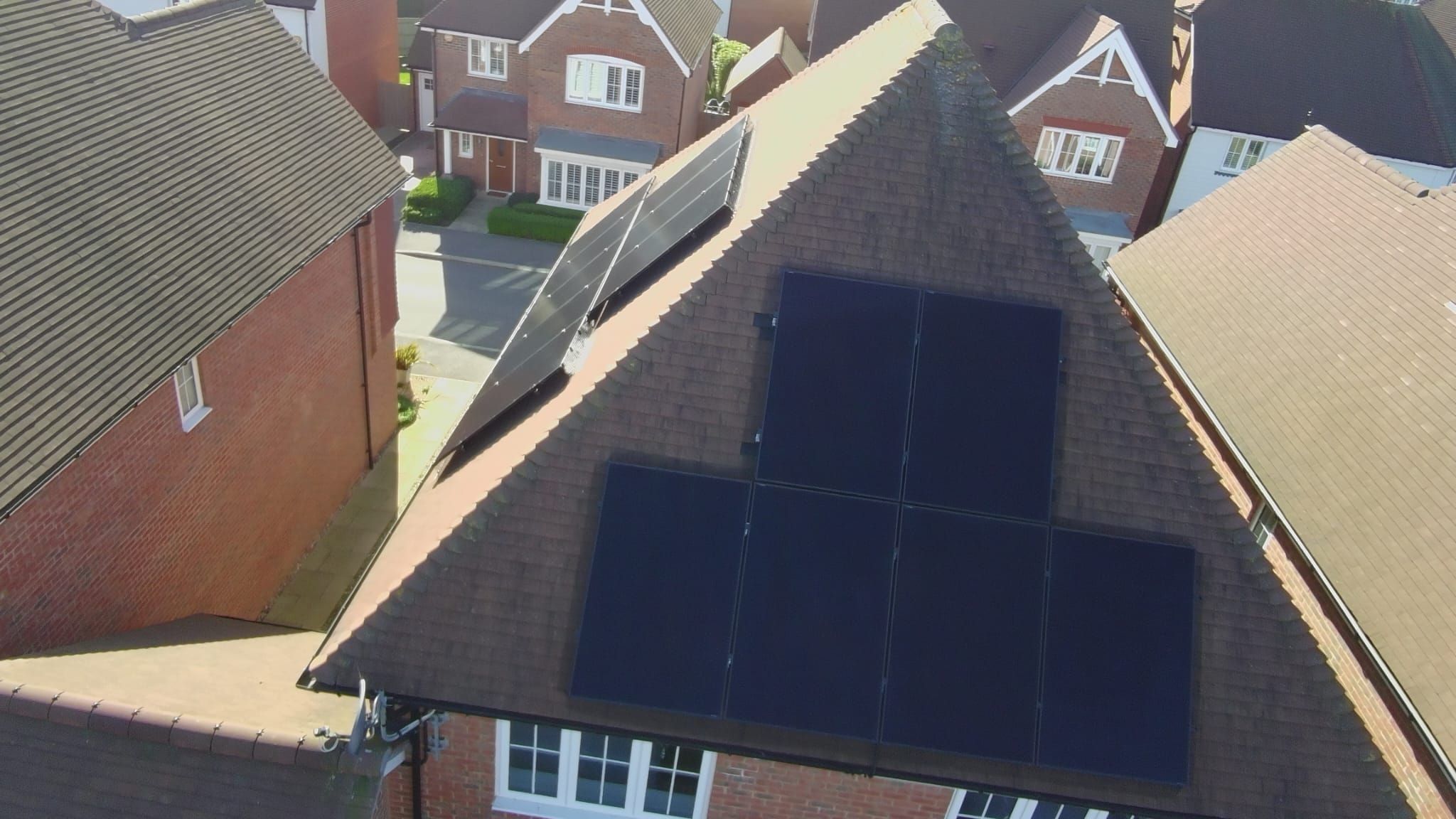
The East Sussex edge of the patch
Solar panel cost in East Sussex
What a domestic system costs on the western end of the county we reach from Washington — Lewes under the Downs and the coast from Newhaven to Peacehaven and Seaford, 23 to 26 road miles from the workshop — the published starting range, the national average, and a worked example from the official yield data, with the assumptions shown.
At a glance
The cost depends on the size of your home and the amount of energy you use, but most domestic solar panel installations in the UK typically start from around £4,000 to £6,000. The Energy Saving Trust, read on 6 October 2026, puts an average home system at about £7,600, typically 4.5 kWp — about 12 panels covering 20 to 30 square metres. On the PVGIS yield for Lewes, that size of array south-facing is worth roughly £994 a year on the assumptions below, an indicative payback of about 7.6 years. Your own price comes from the survey, not from this page.
What decides the price in East Sussex
Two jobs in one county: flint, brick and tile under the Downs at Lewes, inside the National Park, where the planning check comes before the design; and salt-air bungalows and semis on the clifftop from Newhaven to Peacehaven, where marine-grade fixings are the standard specification and the usable battery wall is the first thing we look for.
The whole of this end of East Sussex is UK Power Networks territory — the BN7, BN9 and BN25 districts were checked on 15 October 2026 — so the G98 notification, or the G99 application for an inverter over 16 amps per phase, goes to UKPN, the same operator as Brighton. The MPAN on your bill confirms it. The notification is part of the job and part of the price; so is the scaffold, which is the largest cost after the equipment on most jobs and the item most often left out of a headline figure. Ours is always in.
The county picture — the towns we reach, the roofs we find there and the planning position — is on our solar panels in East Sussex page; the wider picture for the whole patch is on solar panel installers in West Sussex.
A worked example near Lewes
PVGIS, the European Commission’s solar database, read on 15 October 2026: a south-facing array at 35 degrees with a 14% system loss at Lewes (50.87, 0.01) models about 1,177 kWh per kWp a year. Scaled to three common sizes, with 48% used in the house at 26p a unit and the rest exported at 12p:
| System | Generation a year | Used at home | Exported | Worth a year |
|---|---|---|---|---|
| 3.5 kWp | 4,120 kWh | £516 | £257 | £773 |
| 4.5 kWp | 5,297 kWh | £664 | £330 | £994 |
| 6 kWp | 7,062 kWh | £885 | £441 | £1,326 |
Representative figures, not a quote. The 4.5 kWp row against the Energy Saving Trust average of £7,600 gives the 7.6-year indicative payback above. Our own solar savings calculator uses the more conservative MCS figure of 857 kWh per kWp for the South East, so it will show you a lower number on purpose — why the calculator is deliberately cautious explains the gap. This is a modelled figure and it sits a little above the “£4,000 to £6,000” we publish as a typical starting point — your own price comes from the survey, not from this.
Savings first, export second
The value of a system in East Sussex is mostly the electricity you stop buying. On average, UK homeowners save £300–£600 per year, sometimes more if you add battery storage or work from home during the day. Export is the smaller half: the Smart Export Guarantee pays for what you send out — and UK Power Networks is the operator for every address from Lewes to Seaford — and the rate we point people to first is Octopus Energy’s Outgoing Octopus (Fixed) at 12p a unit, correct as of June 2026, cut from 15p to 12p on 1 March 2026, re-checked by November 2026. You do not have to export to the supplier you buy from, and zero VAT and the Smart Export Guarantee, explained plainly covers both schemes.
A battery moves units from the exported column to the used-at-home column, which is where the value is; the honest arithmetic on whether a battery pays is written out, and how storage behaves day to day is the page to read before you decide. The lines we fit — including the Sigenergy stack that can take the car charger too — are chosen at the survey, not from a price list.
VAT, finance and grants
Domestic solar panels and battery storage are zero-rated for VAT — the same at Lewes inside the Park as on a Peacehaven bungalow — and a proper quote simply has no VAT line on it, nothing to claim back. If you would rather spread the cost, the finance calculator on our homepage shows the shape of a monthly figure; we publish no APR there, because the real one comes with the written quote. What counts as a grant in East Sussex, and what does not, is on solar panel grants in East Sussex.
What an East Sussex quote from us contains
On the coast the quote starts with the fixings: marine-grade clamps and containment specified for salt air within a mile of the front, and a ballasted flat-roof system weighted for the wind loading of that roof rather than a catalogue average. At Lewes it starts with the planning position, because inside the National Park a flat-roof array needs the Park Authority’s prior approval and a listed house needs consent. In both the scaffold is priced in, the G98 or G99 goes to UK Power Networks before anything is energised, the battery wall is agreed under PAS 63100 at the survey — away from the seaward side — and the manufacturer registrations arrive in your name.
Lewes is about 23 road miles from Washington and Peacehaven 26, inside the thirty-mile line, so travel is not an item on the quote; Eastbourne, at about 39, is outside our regular area and we say so.
Lewes, Newhaven, Peacehaven and Seaford: two kinds of roof
Lewes is the National Park job: flint and brick under clay tile and slate, a high listed-building count, narrow streets that make the scaffold a design input, and an array that usually ends up on a rear slope or an outbuilding out of the sightline. Newhaven, Peacehaven and Seaford are the coastal job: post-war bungalows and semis on open plots with the sea in view, flat-roofed extensions and garages that take a ballasted system well, and the best light of the three county points we measured — the PVGIS figure near Lewes is 13% above Dorking’s — set against fixings that have to earn their keep in salt air.
The three things people in East Sussex ask before they ask the price
“My Peacehaven roof faces the sea, not the sun.”
A south-westerly or east–west roof on the coast still carries the best light of the three county points we measured; the split spreads the generation across the day rather than losing most of it. The survey models the actual slope and the wind exposure together, and the quote shows the figure for your roof.
“Is the Lewes payback a brochure number?”
Every assumption is in the table above, and our calculator deliberately uses a lower yield than PVGIS does for Lewes. Where a listed house or a shaded rear slope under the Downs makes the numbers thin, we say so — the honest outcome of a survey is sometimes an outbuilding roof instead.
“Do I need the Park Authority’s permission?”
On a roof slope, usually not, even inside the National Park; a flat-roof array there needs prior approval from the Park Authority and a listed house needs consent. The whole position, Park and coast, is in solar panels and planning permission in East Sussex, linked below.
The planning position in full is in solar panels and planning permission in East Sussex.
What you are not committing to in East Sussex
- A free survey of thirty to forty-five minutes at Lewes or on the coast, with nothing to sign at the end of it.
- A written quote afterwards with the marine-grade fixings, the UKPN notification and the battery wall priced and the assumptions shown.
- Where the Park, a listed house or the exposure makes a job not worth doing, we say “not yet” rather than fit it.
- The same electricians do the survey, the install and the certificate: MCS certified · NICEIC Approved Contractor.
Questions we get asked in East Sussex
How much do solar panels cost in East Sussex?
Most domestic installations depend on the size of your home and the amount of energy you use, but start from around £4,000 to £6,000. The Energy Saving Trust, read on 6 October 2026, puts an average home system at about £7,600, typically 4.5 kWp. On the coast the fixings and the battery wall move the price more than the panels do; at Lewes it is the access and the planning position. The survey settles it.
What will a 4.5 kWp system generate near Lewes or on the coast?
PVGIS models about 5,297 kWh a year for a 4.5 kWp south-facing array at 35 degrees near Lewes, with a 14% system loss — roughly 1,177 kWh per kWp, the best of the three county points we measured because of the coastal light. An east–west split, a shallow pitch or a chimney in the wrong place bring it down, which is what the survey is for.
Do you cover Eastbourne or Hastings?
Not as part of our regular working area — Eastbourne is about 39 road miles from Washington, outside the thirty-mile line we work to. Lewes, Newhaven, Peacehaven and Seaford are inside it, and Brighton & Hove has a page of its own.
The next step
Get a East Sussex quote
A free survey on the western end of the county we reach from Washington, then a written quote with the assumptions shown. The figures on this page are representative; yours come from the roof.
- Call 01243 882444
- Email hello@solar-squirrel.co.uk
- Based Washington, West Sussex
If solar genuinely won’t pay for itself on your usage, we’ll say so and save us both an afternoon.
Rather see the numbers before you speak to anybody? Put your own bill on the house — it works out the size, the saving and the payback while you watch, and brings them down to this form with you.